
SCOAP3 Books is now launching the 2026 program and invites all interested publishers to take part in the evolution of the open access books landscape in high-energy physics. If you wish to participate, we encourage you to apply for Open Access funding for books using the following Form. Submitted books should have already successfully passed peer review and been accepted for publication within the next 18 months. The form must be completed for each individual book by April 15th, 2026.
The SCOAP3 for Books initiative has been established as a pilot that the SCOAP3 Governing Council (GC) at its May 2019 meeting to leverage the strong network of the Collaboration and the relationships with scholarly publishing to transition key textbooks and monographs in particle physics and neighboring fields to open access. The pilot phase, conducted from May 2021 to November 2022, converted more than 90 books (monographs and educational texts) to Open Access, thanks to the funding received from more than 60 institutions worldwide. Based on this success, the SCOAP3 Governing Council agreed to establish a recurring books program starting in 2023, prioritizing frontlist titles selected through a rigorous process involving a group of international experts. To date, the program supports the Open Access publication of approximately 10-15 new books annually.
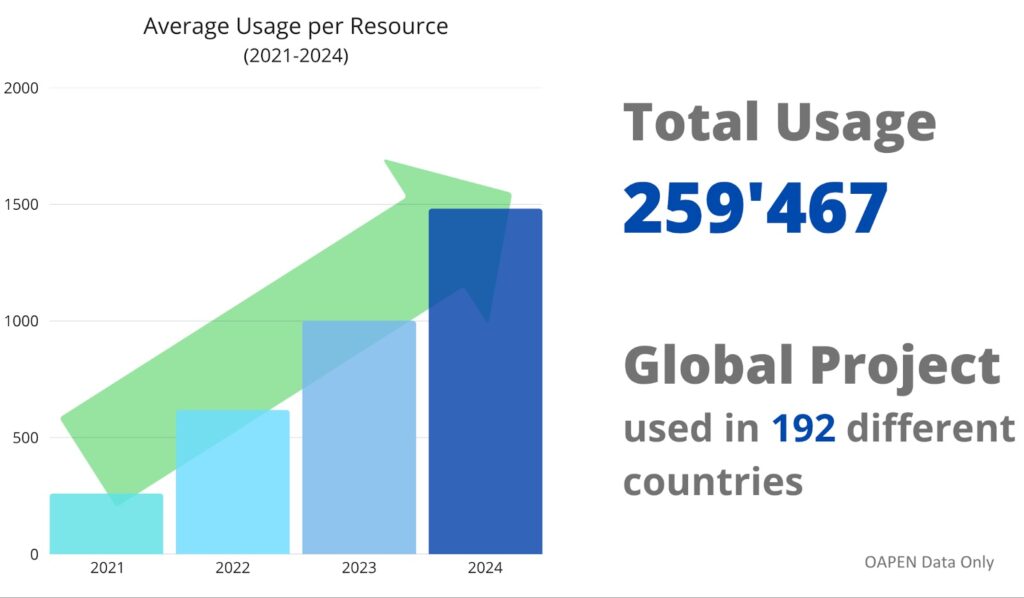
During summer of 2025, a preliminary usage data analysis of SCOAP3 Books was conducted to understand the project’s overall reach and performance. This analysis exclusively utilized data obtained through the OAPEN platform, where all volumes included in the SCOAP3 project are made available. The current results are quite positive. Average usage per individual book grew by a factor of 5.7 from 2021 to 2024. This suggests a growing awareness of the project within the academic community or an increasingly refined selection of volumes over time.
Furthermore, OAPEN data alone demonstrates near-global access coverage since 2021 totalling more than 250,000 downloads on the whole collection available at the end of 2024, with 192 countries using the project.